Key Takeaways
- Immediate Evacuation: If a tree impacts your roof, structural integrity is compromised. Evacuate until an expert confirms it is safe.
- Avoid DIY Tarping: Never attempt to cover a roof while a heavy tree is still resting on it; the tension is unpredictable.
- Documentation Protocol: Clear photos from all angles are necessary for a smooth insurance claims process in Pennsylvania.
- Certified Expertise: Only ISA Certified Arborists should handle removals in tight spaces or near power lines to avoid secondary damage.
- Rapid Response: Pittsburgh’s hilly terrain and narrow lots require a specialized local crew available 24/7.
Pittsburgh is a city defined by its lush, green canopy, but that same beauty becomes a significant liability when severe weather strikes. From the sudden microbursts of summer to the heavy, wet snow-snaps of a Western PA winter, our mature trees are under constant environmental pressure. When the unthinkable happens, and a multi-ton tree crashes onto your roof, the sound is something you never forget. In that moment, panic often sets in, leading homeowners to make hasty decisions that can result in injury or further property loss.
Whether you live in a historic home in Shadyside with a complex slate roof or a modern residence in the wooded hills of Wexford, a tree-to-house impact is a structural emergency. The weight of a mature tree, often exceeding several tons, changes the load-bearing dynamics of your home instantly. This guide provides a disciplined, 4-step framework to help Pittsburgh homeowners navigate the chaos safely, protect their financial interests, and restore their property with professional precision.
The Unique Challenges of Pittsburgh Tree Emergencies
Pittsburgh’s topography complicates emergency tree work more than almost any other major city. Our steep slopes, narrow city streets, and tight residential lots mean that a fallen tree isn’t just a hazard; it’s a logistical puzzle. Many homes in areas like Mount Lebanon or Squirrel Hill are built close together, meaning a tree resting on your roof is likely threatening your neighbor’s property as well. Furthermore, our region’s clay-heavy soil becomes incredibly unstable during saturated conditions, often leading to delayed failures where a tree falls days after the rain has stopped.
Step 1: Immediate Safety and Evacuation
The first and most critical step is the preservation of life. When a tree hits a roof, it rarely just sits there. It creates immense tension and may have compromised the rafters, load-bearing walls, or the foundation itself.
Evacuate the Impact Zone
Do not assume that because the tree didn’t punch through the ceiling, the house is safe. The structural integrity of the home is now unpredictable. Move all residents and pets to a safe location away from the impact site. If the tree is large, consider vacating the house entirely until a structural engineer or a highly experienced tree professional can assess the stability.
Utilities and Fire Hazards
In the Greater Pittsburgh area, trees on roofs almost always involve downed or compromised power lines. Treat every wire as live. If you can safely access your main electrical panel without entering the impact zone, shut off the power to prevent a fire. However, if the tree has impacted the service entrance (where the wires meet the house), do not touch anything.
Step 2: Document the Damage for Insurance
Once everyone is safe and the utilities are addressed, your next priority is documentation. In the aftermath of a storm, your insurance company will be flooded with claims. Having a clear, chronological record of the damage will put you at the front of the line for a fair settlement.
The Visual Record
Using your smartphone, take as many photos and videos as possible from a safe distance. Document the tree’s position, the point of impact on the roof, and any secondary damage to fences, gutters, or landscaping. If you can see the root ball of the tree, take photos of it. Insurance adjusters look for signs of prior negligence versus a healthy tree failure.
Protecting Interior Assets
If it is safe to do so, move valuables away from the area beneath the impact. However, never go onto the roof to tarp a hole while the tree is still there. This is a common mistake that leads to severe falls or being crushed if the tree shifts. Professional mitigation of the hazard must happen before any temporary repairs are made.
Step 3: Call an ISA Certified Arborist for Extraction
This is where the difference between a guy with a chainsaw and a professional tree service becomes apparent. Removing a tree from a roof requires an understanding of physics, weight distribution, and rigging that standard tree removal does not.
The Science of Rigging and Cranes
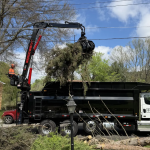
A tree on a house is under tension. If you simply start cutting limbs, the rebound can cause the tree to bounce or roll, causing more damage to your home than the initial impact. Professionals often use cranes to lift the tree vertically, essentially plucking it off the structure. This eliminates the drag factor and prevents the roof from being crushed further.
Expert Assessment of Remaining Trees
After a storm, the trees still standing on your property may be just as dangerous as the one on your roof. A certified arborist will perform a hazard assessment on the rest of your canopy, looking for widow-makers or soil heaving that could lead to another emergency in the next gust of wind.
Step 4: Debris Cleanup and Structural Restoration
After the hazard is removed, the focus shifts to cleanup and long-term recovery. In Pittsburgh, our municipal waste services will not haul away large logs or heavy storm debris. You need a full-service partner who handles the job from the first cut to the final rake.
Full Property Restoration
The heavy equipment used in emergency removals can sometimes stress your lawn, especially on Pittsburgh’s soft, sloping terrain. Ensure your tree service provider uses ground protection mats and offers services like topsoil and grass seeding to restore your yard to its pre-storm beauty.
Documenting the Removal Cost
Keep all invoices. Most Pittsburgh homeowners’ insurance policies cover debris removal if a tree hits a covered structure. A reputable tree service will provide itemized billing that clearly distinguishes between the extraction (emergency) and hauling (cleanup) to help your adjuster process the claim accurately.
When a tree emergency strikes in the Greater Pittsburgh area, you need a team that combines rapid response with certified expertise. Tripoli Tree Care is a locally-owned and operated company rooted in our community, dedicated to providing 24/7 emergency tree service throughout Allegheny and Washington Counties.
Tripoli Tree Care offers a wide range of tree care services, such as tree removal, tree trimming & pruning, stump grinding, 24/7 emergency tree service, storm damage cleanup, debris removal, tree planting, shrub planting, commercial tree services, land clearing, and topsoil & grass seeding that ensure your new trees have the best start possible. We are ISA Certified Arborists, TCIA members, and BBB A+ rated, ensuring that every emergency removal is handled with the highest ethical and safety standards.
Trust Tripoli Tree Care to stand as the frontline defense for your property’s trees. Call us today at (412) 659-8267 for a free estimate.
Frequently Asked Questions by Homeowners in Pittsburgh, Pennsylvania
1. Does homeowners’ insurance cover the cost of removing a tree from my roof in Pittsburgh, Pennsylvania?
Yes, typically. If a tree hits a covered structure like your house or garage, most policies cover the cost of professional removal and the repairs to the structure. Tripoli Tree Care works directly with insurance providers to simplify the documentation and billing process.
2. How quickly can Tripoli Tree Care respond to an emergency in Pittsburgh?
We offer 24/7 emergency service. Our crews are stationed to reach areas like Upper St. Clair, Shadyside, and Sewickley quickly, often within hours of the initial call, depending on storm volume and safety conditions.
3. What if a neighbor’s tree falls on my roof?
In Pennsylvania, if a neighbor’s tree falls on your house due to a storm, it is generally considered an Act of God, and you file the claim through your insurance policy. We can provide the arborist report needed to document the situation for your adjuster.
4. Can you remove trees from roofs in tight city neighborhoods in Pittsburgh, Pennsylvania?
Absolutely. We specialize in tight-access removals. Our advanced equipment and rigging techniques allow us to safely lift trees from houses in narrow lots like those found in Squirrel Hill or O’Hara Township without impacting neighboring homes.
5. Is a permit required for emergency tree removal in Pittsburgh?
In true emergencies where a tree is a direct threat to safety or a structure, the removal can usually proceed immediately. We handle the necessary follow-up documentation and compliance with local Allegheny County codes.
6. What happens if a tree is touching power lines?
Safety first: do not touch the tree. We coordinate with local utility companies to ensure the lines are de-energized before our arborists begin the extraction process.
7. Do you provide a written estimate for emergency work in Pittsburgh, Pennsylvania?
Yes. We believe in transparent, no-surprise pricing. Even in an emergency, we provide a clear scope of work and a fair price before the work begins.
8. Will the removal process damage my lawn?
We take immense pride in respecting your property. We use modern equipment and protective measures to minimize the footprint on your landscape, and we offer topsoil and seeding to repair any unavoidable stress to the turf.
Summary Checklist: Post-Storm Emergency Response
| Action Item | Responsibility | Priority |
| Evacuate the House | Homeowner | Immediate |
| Call Utility Provider (if lines are down) | Homeowner | Immediate |
| Contact Tripoli Tree Care (412) 659-8267 | Homeowner | High |
| Photograph All Damage | Homeowner | High |
| Arborist Safety Assessment | Tripoli Tree Care | High |
| Crane-Assisted Extraction | Tripoli Tree Care | High |
| Insurance Claim Documentation | Tripoli/Homeowner | Medium |
| Final Debris Hauling & Seeding | Tripoli Tree Care | Medium |
Final Advice
When a tree impacts a roof in Pittsburgh, the emergency response requires a swift transition from panic to a structured safety protocol. Your primary objective as a homeowner is to manage the risk to life and property by following the 4-step framework: evacuate immediately, document the damage extensively, secure professional extraction, and oversee the restoration.
- Do not attempt to mitigate a tree-to-structure emergency using standard manual methods or DIY tarping; the complex physics of a leaning multi-ton tree can cause a secondary structural collapse if not handled with vertical lift equipment and expert rigging.
- By hiring an ISA Certified Arborist who understands Pittsburgh’s unique architecture and topography, you ensure that the extraction is performed surgically, preventing further harm to your shingles, gutters, and rafters.
- A professional response ensures your insurance documentation is technically accurate, maximizing your chances of a successful claim.
- Act decisively by calling a 24/7 emergency service that provides both the heavy machinery for safe removal and the ground-level services like seeding to restore your property. Safety and structural integrity are non-negotiable; rely on certified experts to turn a chaotic storm event into a managed recovery.