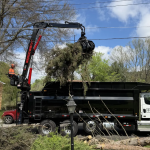
Hillside tree removal in Pittsburgh costs more than flat-ground work because the city’s steep slopes, narrow lots, and tight access force crews to use specialized equipment and slower, more careful methods. Standard bucket trucks often cannot reach a hillside tree, so crews turn to spider lifts or crane-assisted rigging, add crew members, and take more time to control every section as it comes down. Terrain is one of the biggest cost drivers for tree removal in Pittsburgh, and ISA Certified Arborists with local experience plan these removals to protect your home, your yard, and your neighbors.
Ask anyone who has tried to back a moving truck into a South Side Slopes driveway and they will confirm what Pittsburgh residents already know: this city was not built on flat land. From the bluffs above the Monongahela to the wooded ravines of Fox Chapel, the terrain is defined by elevation changes, narrow ridge lots, and steep backyards. That topography is part of what makes Pittsburgh beautiful, but when a large oak on a 40-degree slope needs to come down, the same terrain becomes a serious complication that affects safety, equipment, crew logistics, and cost. There is more on why Pittsburgh hillsides complicate removal in our full breakdown.
Why Does Slope Change Everything About Tree Removal?
On flat ground, tree removal follows a predictable workflow: assess the tree, set a felling or rigging plan, bring in equipment, chip or haul debris, grind the stump, and rake clean. On a Pittsburgh hillside, every one of those steps gets harder.
Equipment access
Most large removal equipment, bucket trucks, chippers, and log loaders are designed for level or near-level ground. On a steep lot, a bucket truck may be impossible to position safely. Crews often rely on compact spider lifts, which reach 70 feet or more, fit through 36-inch gates, and spread their weight without tearing up steep turf, though they take more setup time and more skill to run on vertical terrain.
Rigging and section work
When a tree cannot be felled in one direction, crews dismantle it in sections from the top down. Each section has to be rigged and lowered under control, because a log rolling free on a hillside can travel far and hit a fence, structure, or parked car downhill. Precision rigging on a slope needs more anchor points, more crew, and more time than equivalent flat-ground work, and steep jobs often call for crane-assisted rigging.
Soil conditions and root stability
Pittsburgh’s clay-heavy soils saturate after heavy rain, and the city averages over 40 inches of precipitation a year. On a slope, saturated soil means less friction and less grip at the root plate. Trees that look stable can be more compromised than they appear, especially after a wet spring or freeze-thaw cycling, so a root zone assessment is essential before any hillside removal, and it is part of what we check before a large removal.
Debris management
On flat ground, chips and logs land roughly where expected. On a hillside, debris follows gravity, so chipping requires careful positioning and sometimes hand-carrying material uphill to the chipper. Cleanup after a hillside removal is more demanding and time-consuming than flat-ground work of the same scale.
Which Pittsburgh Neighborhoods Have the Most Terrain Challenges?
Some areas see this more than others:
- Mt. Washington and Duquesne Heights: among the steepest residential slopes in the city, where large trees frequently require crane-assisted tree removal or multi-day large tree removals.
- South Side Slopes: densely packed historic housing on severe grades, with very limited equipment access. Many lots are reachable only with tracked machinery.
- Squirrel Hill and Greenfield: a mix of flat and severely sloped sections, mature canopy, and historic homes close together, with tight lots and overhead utility lines.
- Fox Chapel and O’Hara Township: larger properties, but heavily wooded with trees on ravine edges and creek banks where equipment placement is constrained.
What Does Pittsburgh Terrain Mean for Your Quote?
What tree removal costs is never just about the size of the tree. On a Pittsburgh hillside, these factors push the price up compared to a flat-lot removal of the same tree:
- Equipment required (spider lift vs. bucket truck vs. crane)
- Number of crew members needed to rig and manage sections
- Time for setup, rigging, and controlled lowering
- Additional debris management on slopes
- Possible multi-day scheduling for complex removals
A 60-foot oak on a level suburban lot might be a straightforward half-day job. The same tree on a 35-degree slope in Mt. Washington, above a neighbor’s garage with limited street access, is a very different operation. A contractor who quotes them identically either has not assessed the site properly or is planning to cut corners. For any hillside removal, an in-person assessment is essential, and a written estimate that breaks down site challenges, equipment plan, and scope gives you a far clearer picture than a phone number.
Tripoli Tree Care was built for Pittsburgh, not adapted from a flatland operation. Our fleet includes compact spider lifts for hillside and gate-restricted access, 75-foot bucket trucks for properties with reasonable approach, and precision rigging for controlled section work in tight, sloped environments. We use AlturnaMATs on soft or sloped ground to distribute weight and prevent lawn ruts. Before any crew picks up a saw, we complete a strategic safety assessment: mapping access, evaluating root zone conditions, checking proximity to structures and utilities, and selecting the right equipment. You can see our equipment and the terrain we have worked, from the river bluffs in Coraopolis to the ravine lots in Fox Chapel. Call us at (412) 659-8267 to book your free estimate.
Frequently Asked Questions About Hillside Tree Removal in Pittsburgh
Does a steeper lot always mean a more expensive tree removal?
Not always, but terrain is one of the most significant cost variables in Pittsburgh. A steep lot with good open access may be simpler than a flat lot with a tree directly over a garage roof.
Can a hillside removal be done in one visit?
Many are, but complex jobs, large trees in tight, sloped spaces with significant rigging, may be scheduled over two days. We tell you upfront what to expect before work begins.
Will equipment damage my hillside lawn?
We use AlturnaMATs and tracked equipment to minimize ground disturbance. No approach is completely without impact, but our choices reduce damage compared to standard wheeled machinery.
Do I need a permit for tree removal on a hillside property?
Permit requirements depend on tree ownership, proximity to utilities, and zoning. Our team is familiar with Allegheny County ordinances and Pittsburgh tree removal permits and can advise on what applies before any work begins.
How much more does a hillside removal cost than a flat-lot one?
It varies with slope, access, and equipment, but hillside jobs commonly run meaningfully higher than the same tree on flat ground because of added crew, rigging, and time. The only accurate number comes from an on-site look.
Can you remove a tree with no yard access, only a narrow gate or stairs?
Often yes. Our compact spider lifts fit through 36-inch gates and reach tight back lots that a truck cannot, which is exactly the situation they are built for.
Do you remove trees on ravine edges or creek banks?
Yes. Those lots need careful rigging and anchor planning, and we assess root stability and footing before the crew starts.
How do you protect my neighbor’s property downhill during a removal?
We rig and lower each section under control rather than letting anything fall free, set the drop zones around downhill structures, and plan access so debris does not travel. This is a core reason hillside jobs take more crew and time.
Is stump grinding harder on a slope?
It can be, since the grinder has to be positioned and stabilized on uneven ground. We quote it with the job once we see the site.
Do you give free estimates for hillside removals?
Yes. Hillside quotes should always be done in person, and ours are free with a written scope so you know the equipment plan and price before work begins.
Summary Checklist: Hillside Tree Removal in Pittsburgh
| Condition | Risk Level | Recommended Action |
| Large tree on steep slope near a structure | High | Schedule professional assessment immediately; do not attempt DIY |
| Tree leaning or showing root heave on hillside | High | ISA Certified Arborist inspection before next storm season |
| Tree removal on lot with limited equipment access | Moderate | Request in-person estimate; phone quotes are not adequate |
| Post-removal lawn restoration on slope | Ongoing | Ask about topsoil and seeding to stabilize exposed soil |
| Routine tree maintenance on sloped wooded lot | Ongoing | Annual pruning and inspection to reduce emergency risk |
Final Advice
Pittsburgh’s terrain is what makes this city distinctive and what makes tree work here more demanding than in flatter markets. The hills are not a reason to avoid necessary removals, they are a reason to choose a specialized, professional tree service with the right equipment, training, and local experience. A thorough site assessment, a written scope, and a crew that knows Pittsburgh’s terrain separate a smooth removal from a costly mistake. For a free, in-person estimate, contact Tripoli Tree Care at (412) 659-8267.