Key Takeaways
- Heavy rain can loosen soil around tree roots and increase the risk of uprooting, especially on steep slopes and properties with clay-heavy soil.
- Fresh movement, exposed roots, lifted soil, cracks, and a sudden change in the tree’s angle are warning signs that should never be ignored.
- A leaning tree is not automatically dangerous, but a new or worsening lean requires prompt inspection by a qualified arborist.
- Homeowners should stay away from unstable trees and never attempt to cut or climb them after severe weather.
- Tripoli Tree Care provides 24/7 emergency tree service, storm damage cleanup, tree removal, and hazard assessments throughout Pittsburgh and Allegheny County.
Heavy rain can create serious problems for trees across Pittsburgh, especially when storms saturate the soil around their roots. Tree roots depend on surrounding soil for support. When that soil becomes saturated, it can lose some of its ability to hold the root system firmly in place. This becomes more concerning when heavy rain is followed by strong winds. Wind places pressure on the trunk and canopy while saturated soil provides less support below ground. A tree that appeared stable before the storm can begin to lean, shift, or uproot.
Pittsburgh properties can be especially challenging because many homes are located on hillsides, narrow lots, and uneven terrain. A tree may stand above a home in Mount Washington, beside a driveway in Upper St. Clair, or close to utility lines in Squirrel Hill. If the ground becomes unstable, a falling tree can damage much more than the surrounding landscape.
Rain does not automatically make a healthy tree dangerous. The greater concern is the combination of saturated soil, strong wind, shallow roots, existing root damage, heavy foliage, and structural defects. Trees growing on slopes or in compacted soil may have less stability when the ground becomes waterlogged.
Pittsburgh also experiences other seasonal stresses, including wet snow, ice, freeze-thaw cycles, and strong storms. These conditions can compound existing weaknesses. Local precipitation and climate information from the National Weather Service Pittsburgh office can help homeowners understand the wet-weather conditions that affect the region.
Signs of an Unstable Tree After Heavy Rain
A new or worsening lean is one of the most important warning signs. Some trees naturally grow at an angle. A long-standing lean does not necessarily mean the tree is about to fall. However, a tree that suddenly changes position after heavy rain deserves prompt attention.
- Start by looking at the soil around the base from a safe distance. Fresh cracks, raised soil, depressions, or a section of ground that appears to have lifted may indicate root movement. Soil that has separated from the root plate is particularly concerning.
- Exposed roots are another warning sign. Roots that were previously covered may become visible when the soil shifts or washes away.
- Do not attempt to cover the roots, push the tree upright, or pack soil around the base. These actions can make the situation harder to assess.
- Look for movement at the trunk base. If the tree rocks in light wind or appears to move independently from the surrounding ground, its root system may be losing support.
- Cracks in the trunk, split branch unions, hanging limbs, and fresh bark damage can add to the risk.
- The location of the tree also matters. A leaning tree over an open lawn presents a different level of concern than one positioned above a house, garage, driveway, sidewalk, road, fence, or power line. These areas are considered potential targets because a falling tree or branch could cause injury or significant property damage.
Understanding Root Plate Movement
The root plate is the mass of roots and soil that helps anchor a tree. When a tree begins to uproot, the root plate may lift on the side opposite the direction of the lean. Homeowners may notice a curved wall of soil, exposed roots, or a visible gap beneath part of the root system. In some cases, the tree remains standing because nearby roots, surrounding trees, or branches are temporarily holding it in place.
- A lifted root plate should be treated as a serious hazard. Additional rain can weaken the surrounding soil even further. Another wind event may then cause the tree to move or fall.
- Do not park beneath the tree or walk through the affected area.
- Keep children and pets away.
- Do not attempt to cut branches to make the tree lighter.
- Cutting can change the tree’s balance and may release stored tension in the trunk or branches.
- Straightening and staking are not always practical solutions for a mature tree with root failure.
If major roots have broken or the surrounding soil has shifted, the tree may no longer have enough support to remain stable. An ISA-certified tree service firm in Pittsburg, Pennsylvania should evaluate the root plate and site before deciding whether stabilization, pruning, or removal is appropriate.
Other Fall Hazards to Look For
Heavy rain can expose problems that are already developing inside or around a tree.
- Saturated soil may reveal weak roots, but storms can also increase the chance of defective branches breaking.
- From a safe location, look at the canopy for dead branches, hanging limbs, fresh breaks, and branches that are rubbing against each other.
- Large branches resting on other branches or structures should also be treated as potential hazards. The trunk deserves attention as well.
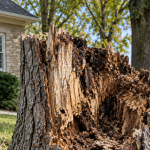
- Vertical cracks, cavities, fungal growth, hollow areas, and weak unions between major stems may indicate structural problems. These signs do not automatically mean that the entire tree needs to be removed. They do, however, justify an in-person assessment.
- Previous construction can also affect tree stability. Excavation, grading, trenching, paving, and soil compaction can damage roots without causing obvious symptoms right away. Years later, heavy rain may reveal that the tree has less root support than it once did.
- Trees weakened by previous storms, pests, disease, or lightning may also be more vulnerable. A tree that has survived several storms is not necessarily a tree that will remain stable indefinitely. Existing defects can become more serious as the tree ages.
What Homeowners Should Do After Heavy Rain
If a tree has shifted, cracked, or developed lifted soil after heavy rain, stay away from the area.
- Keep children and pets away from the tree and avoid parking vehicles beneath the canopy.
- Never climb an unstable tree or attempt to pull it upright.
- Do not attach ropes, use a chainsaw, or remove major branches yourself. A partially uprooted tree can move suddenly, and branches or trunks under tension can release with significant force.
- Power lines require additional caution. If a tree or branch is touching a utility line, assume the line may be energized.
- Do not approach the tree or attempt to remove the branch. Contact the utility provider and keep everyone away from the area.
- If it is safe to do so, photographs can be useful for an arborist or insurance provider. Take pictures from a distance and do not enter the hazard zone simply to document damage.
A qualified arborist can evaluate the tree’s species, size, lean, root condition, structural defects, and surrounding targets. The assessment can determine whether selective pruning, stabilization, or complete removal is the safest option.
Professional Help for Leaning and Storm-Damaged Trees
Tripoli Tree Care is a locally owned Pittsburgh tree service serving homeowners, businesses, HOAs, and other properties throughout Allegheny County and nearby communities. Our team handles situations ranging from newly leaning trees and storm damage to hazardous trees that require controlled removal. Our ISA Certified Arborists can assess root movement, structural defects, storm damage, and potential fall hazards before recommending the appropriate course of action.
Tripoli Tree Care provides 24/7 emergency tree service for situations involving trees that have fallen on homes, vehicles, fences, driveways, and other property. Depending on the property and the tree, our crew uses precision rigging, compact spider lifts, bucket trucks, ground mats, and crane-assisted removal methods. These techniques are particularly useful on steep, confined, or difficult Pittsburgh properties where equipment access is limited. Proper planning can help protect lawns, gardens, structures, and surrounding property during emergency tree work.
Tripoli Tree Care is fully licensed and insured and provides written assessments and photographic documentation for storm-related insurance claims. Homeowners can receive free estimates, clear pricing, no-surprise communication, and a workmanship guarantee. For assistance with a leaning or storm-damaged tree.
Frequently Asked Questions About Heavy Rain and Leaning Trees in Pittsburgh, Pennsylvania
Can heavy rain make a healthy tree fall?
Yes. Heavy rain can saturate the soil and reduce its ability to hold roots securely. If strong wind, shallow roots, slope movement, or an existing structural defect is also present, even a healthy-looking tree can become unstable.
Is every leaning tree dangerous?
No. Some trees naturally grow at an angle and remain stable for many years. A sudden or worsening lean is more concerning, especially when it occurs with lifted soil, exposed roots, trunk cracks, or unusual movement after rain.
How soon should a leaning tree be inspected?
A newly leaning tree should be inspected as soon as conditions are safe. This is especially important when the tree is near a home, driveway, sidewalk, road, retaining wall, or power line. Waiting can allow additional rain or wind to increase the damage.
Can a leaning tree be straightened?
Sometimes. A young tree with healthy roots may be suitable for stabilization. A mature tree with a lifted root plate, broken roots, or major soil movement may not be safely restorable. An arborist should inspect the tree and soil before recommending any corrective action.
Should I cut branches off a leaning tree?
Homeowners should not remove major branches from an unstable tree. Cutting can change the tree’s balance and release stored tension. A professional crew can determine whether selective pruning would reduce risk or whether removal is necessary.
Does homeowners insurance cover storm-damaged tree removal?
Coverage depends on the individual insurance policy. Some policies cover tree removal when a fallen tree damages an insured structure, while other situations may be handled differently. Photograph the damage safely and contact your insurance provider for specific coverage information.
Can Tripoli Tree Care help after heavy rain?
Yes. Tripoli Tree Care provides emergency tree service, storm damage cleanup, hazardous tree removal, tree assessments, and debris removal throughout Pittsburgh and Allegheny County. Call (412) 659-8267 for assistance.
Summary Checklist: Leaning Tree Fall Hazards
| Task | Priority | Recommended Action |
| Check for a new or worsening lean | Critical | Keep away from the tree and arrange an urgent inspection. |
| Look for lifted soil | Critical | Treat raised soil and exposed roots as possible signs of root plate failure. |
| Identify nearby targets | High | Keep people and vehicles away from homes, driveways, sidewalks, and fences. |
| Inspect from a safe distance | High | Look for cracks, broken limbs, hanging branches, and trunk movement. |
| Stay away from power lines | Critical | Contact the utility company and never approach an energized line. |
| Avoid DIY cutting | Critical | Do not climb, pull, brace, or operate a chainsaw near an unstable tree. |
| Document the damage | Moderate | Take photographs from a safe location for an arborist or insurance provider. |
| Arrange a professional assessment | High | Have an arborist determine whether pruning, stabilization, or removal is appropriate. |
| Check local requirements | Moderate | Confirm rules for public trees, rights-of-way, permits, or regulated work. |
Final Advice
Heavy rain can change the stability of a tree by weakening the soil around its roots. A tree that appeared secure before a storm may become unstable when saturated soil combines with wind, slope movement, root damage, or existing structural defects.
A new lean, lifted root plate, exposed roots, fresh cracks, or movement at the base should never be ignored. The safest response is to keep people and vehicles away from the area and arrange a professional inspection. Homeowners should never attempt to straighten, climb, cut, or pull an unstable tree themselves. This is especially important when the tree is near a home, road, power line, retaining wall, or other frequently used area. A professional assessment can determine whether the tree can be preserved through pruning or stabilization or whether controlled removal is the safer option.