Key Takeaways:
- Cranes allow the safe removal of trees that are too unstable or too large for traditional climbing methods
- Pittsburgh’s hilly terrain and dense neighborhoods make crane-assisted removal more common here than in most cities
- Vertical lifts eliminate the risk of heavy sections damaging roofs, power lines, and surrounding structures
- Crane removal often reduces total time on site compared to manual rigging methods
- Hiring an ISA Certified Arborist with documented crane experience is essential for protecting your property
Tree removal is far from straightforward. Steep hillside lots, narrow backyards, historic streetscapes, and sloped residential roads all create challenges that simply don’t exist on flat, open terrain. Picture a massive oak growing directly over a roofline with no clear fall zone, or a storm-damaged elm leaning toward utility lines on a tight urban lot, or a decayed trunk on a steep hillside where a falling log could roll straight into a structure below. These are the situations where traditional tree removal reaches its limits. They are also the situations that define why crane-assisted tree removal exists.
This article explains exactly how crane-assisted removal works, when it becomes necessary, and what every Pittsburgh property owner should understand before hiring a company to handle one of these high-stakes jobs.
The Science of the Lift: How Crane-Assisted Removal Works
Crane-assisted tree removal is designed for situations where traditional methods are too risky. In standard removal, a climber cuts sections from the top down, letting them fall into a clear landing zone. This works well with plenty of open space, but in tight or delicate areas, dropping wood freely can be dangerous.
Crane-assisted removal changes the process entirely. This is how –
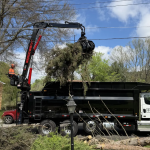
- A crane lifts each section immediately after it is cut, carrying it safely away from obstacles below.
- The operation relies on precise coordination between a certified arborist in the canopy and the crane operator outside the work zone.
- It begins with a detailed site assessment, mapping crane positioning, confirming ground stability, and planning the sequence of cuts.
- Ground protection mats are placed to safeguard driveways and turf while supporting the crane’s weight.
- The arborist attaches slings or cables to each section, and once the crane has tension, the cut is made.
- The crane lifts and swings the section to a designated drop zone, where the ground crew processes it.
- The process repeats section by section, ensuring nothing falls freely and every piece is safely accounted for.
This meticulous approach allows for safe, controlled removal even in areas where space is limited or obstacles abound.
Why Pittsburgh Properties Benefit from Cranes More Than Most
Crane-assisted tree removal exists in every major American city, but Pittsburgh property owners encounter situations that require it with unusual frequency. The city’s defining geographic and architectural characteristics are largely responsible.
a.) Tight Urban Spaces With No Ground Access
Homes throughout Sewickley,Fox Chapel, and Squirrel Hill are frequently built close together, often with a narrow side gate as the only route between the street and the backyard. Getting heavy ground equipment through a gap like that is not realistic. A crane positioned on the street can reach directly over the house and lift sections out of a backyard that would otherwise be completely inaccessible. No squeezed equipment, no torn-up landscaping, no compromises on safety.
b.) The Slope Problem Unique to Pittsburgh
On flat ground, a falling log lands. On Pittsburgh’s hillsides, it rolls. Properties throughout Troy Hill, Duquesne Heights, and Beechview sit on grades steep enough that an uncontrolled section of wood can gain significant momentum and cause serious damage to structures further downhill. A crane removes gravity as a factor entirely. Every section is controlled from the moment of the cut to the moment it reaches the ground crew.
c.) Preserving Finished Landscapes
Traditional removal involves dropping heavy wood sections, and heavy wood sections leave marks. Ruts, divots, and compacted soil from repeated impacts can take a full growing season or more to recover. Because a crane carries the full weight of each section through the air, the physical impact on the ground below is minimal. For Pittsburgh homeowners who have spent years developing mature gardens and finished yards, that difference is significant.
When a Crane Is Not Just Helpful But Necessary
There is a distinction between situations where a crane makes a job easier and situations where a crane makes a job possible. The following scenarios fall firmly in the second category.
a.) Structurally Compromised or Heavily Decayed Trees
A tree with significant internal decay or advanced rot presents a specific danger: the trunk can shift, crack, or collapse unpredictably under a climber’s weight or the vibration of a chainsaw. Sending an arborist up a tree in that condition without crane support puts a person’s life at serious risk. A crane minimizes the time a climber needs to spend on an unstable trunk and ensures every section is mechanically supported before the cut is made. The unpredictability of decayed wood stops being a factor when the crane is carrying the load.
b.) Storm-Damaged Trees Resting on Structures
After a major Western Pennsylvania thunderstorm, one of the most dangerous situations a property owner can face is a large tree or heavy limb that has partially failed and is resting against a roof or exterior wall. The weight distribution in a scenario like this is already compromised. Attempting to cut the tree free without mechanical support risks causing the remaining load to shift suddenly, worsening structural damage or injuring the crew. A crane stabilizes the tree’s weight before any cutting begins, allowing sections to be lifted away from the structure rather than dropped onto it.
c.) Trees Growing Into or Leaning Toward Power Lines
Utility line proximity is one of the most unforgiving constraints in tree removal. When a tree has grown into high-voltage lines or is leaning in their direction, the margin for error is essentially zero. Crane-assisted removal provides the controlled vertical lift that ensures no part of the tree makes contact with the lines during the process. In Pittsburgh’s older neighborhoods, where mature street trees and utility infrastructure have grown up alongside each other for decades, this scenario is more common than most property owners realize.
d.) No-Fall-Zone Situations in Dense Neighborhoods
When a tree is hemmed in on every side by a home, a garage, a fence, and a neighboring property, there is no direction it can safely fall. This is a straightforward no-fall-zone situation, and it eliminates traditional felling as an option entirely. A crane converts what would otherwise be an impossible removal into a routine sectional lift, taking each piece straight up and away regardless of what surrounds the tree at ground level.
The Role of the Certified Arborist: Why Credentials Are Non-Negotiable
Crane-assisted tree removal is a high-stakes operation, and the qualifications of the people performing it matter enormously. The most critical technical requirement is accurate green wood weight calculation. Every section being lifted must be within the safe operating limits of the crane. A miscalculation does not produce a minor inconvenience. It can tip the crane, snap the rigging, or send a section of wood falling in an unintended direction.
ISA Certified Arborists have the training to make these calculations correctly under real job conditions. They understand wood density by species, how moisture content affects weight, and how the physics of the lift interact with the crane’s rated capacity. That knowledge is not something a general laborer with equipment access can replicate.
When evaluating any Pittsburgh tree company for crane work, property owners should ask directly:
- Are your arborists ISA certified?
- Does your crane operator hold current certifications?
- Can you provide documented examples of crane removals on properties similar to mine?
These are not questions that should be answered vaguely. For Pittsburgh property owners facing a complex or hazardous removal, Tripoli Tree Care brings the equipment, credentials, and local knowledge the job requires. Based at 2525 Winchester Dr, Tripoli Tree Care is a locally owned, BBB A+ rated company whose ISA Certified Arborists specialize in crane-assisted removals across the Pittsburgh metro area.
Our team has worked the full range of Allegheny County conditions, from tight urban lots in Fox Chapel to steep hillside removals in Mount Lebanon and Upper St. Clair, and every job begins with a detailed site plan and full property protection measures!
Frequently Asked Questions by Homeowners in Pittsburgh, Pennsylvania
How much space does a crane need to set up on a Pittsburgh property?
A crane typically needs a clear, stable area roughly the size of a few parking spaces. The crew evaluates your specific property during the site assessment to identify the most practical and least disruptive placement.
Will the crane damage my driveway or lawn?
Professional crews use specialized outrigger pads to distribute the machine’s weight across a wider surface area. This prevents sinking and protects both pavement and turf from damage under the crane’s load.
Can crane removal be performed in any weather?
High winds are the primary safety concern and the most common reason for rescheduling. Light rain is generally workable, but if wind speeds exceed safe operational limits, the job is postponed to protect both the crew and your property.
Is crane-assisted removal significantly more expensive than traditional methods?
The crane carries an operational cost, but it dramatically reduces total hours on site. A removal that might require two full days of manual work can often be completed in four hours with a crane, making the overall cost more competitive than most property owners anticipate.
How do I know if my specific tree needs a crane?
A site-specific assessment by a certified arborist is the only reliable way to answer that question. Tree health, proximity to structures and utility lines, available drop zone space, and slope conditions all factor into the determination.
Is crane removal safer for the crew as well as the property?
Significantly. It reduces climber exposure to unstable wood, eliminates the physical risks of manual rigging on difficult terrain, and makes the entire job site safer for everyone involved from start to finish.
What happens to the wood once it is removed?
Each section is lowered directly to the processing area. From there, the material can be chipped, hauled away entirely, or cut into usable logs, depending on the property owner’s preference.
Summary Checklist: When to Call for Crane-Assisted Removal
| Condition | Risk Level | Recommended Action |
| Dead tree overhanging a roof | Critical | Immediate crane-assisted removal to prevent structural damage |
| Tree leaning toward power lines | High | Schedule a crane pick to ensure a controlled vertical lift |
| Uprooted tree on a steep slope | High | Use a crane to stabilize the trunk before any cutting begins |
| Storm-damaged split trunk | Critical | Emergency assessment; crane support essential during dismantling |
| Heavily decayed trunk unsafe to climb | Critical | Crane removal to eliminate climber exposure to unstable wood |
Final Advice
Crane-assisted tree removal is best understood as a risk management decision rather than a premium service upgrade. When a tree’s size, condition, or location creates a situation where no section can be allowed to fall freely, removing gravity as a variable is not a luxury. It is the only responsible approach. Pittsburgh property owners evaluating a hazardous tree should think beyond the visible trunk and consider the full target area, the entire radius within which debris could land if something goes wrong. When that radius includes a roof, utility lines, a neighboring structure, or a downhill slope, the margin for error in manual rigging becomes unacceptably narrow.
The most practical and cost-effective move is always to address a compromised tree before it becomes an emergency. Crane technology has made previously impossible removals routine, and acting before Western Pennsylvania’s storm season rather than after it is consistently the less expensive and less stressful path. Mature trees that have grown alongside homes and utility lines for decades deserve regular professional assessment. Catching structural problems early is what keeps a crane removal from becoming a crisis response.