If you’ve gotten two tree removal quotes and noticed one company plans to bring a bucket truck while another plans to send a climber up with ropes, that’s not one of them being wrong. It usually means they looked at your property and reached different, both reasonable, conclusions about access, or it means one of them didn’t actually look closely enough before quoting. Either way, it’s a fair question to ask, and it deserves a real answer instead of “that’s just how we do it.”
Pittsburgh makes this decision more complicated than flatter, newer cities do. Narrow lots, steep hillside streets, overhead lines strung close to houses, and alleys that were never meant for modern equipment all factor into which method actually works on a given job. Here’s how that decision gets made and what it means for your project.
Quick Answer
Bucket trucks work best on open, accessible sites where a truck can park within reach of the tree and extend its boom without obstruction. Climbing is used when access is limited, the site is too tight or steep for a truck, or the tree’s condition requires a climber to assess and cut sections from inside the canopy. Neither method is inherently safer or better; the right choice depends on the tree, the site, and what the job actually requires.
Table of Contents
- What a Bucket Truck Removal Actually Looks Like
- What a Climbing Removal Actually Looks Like
- Comparing the Two Methods
- Why Pittsburgh Properties Often Require Climbing
- When a Bucket Truck Is the Better Choice
- Safety Standards Behind Both Methods
- What We Commonly See in the Field
- Cost Differences and Why They Exist
- What Homeowners Can Do Now
- Frequently Asked Questions
- Key Takeaways
What a Bucket Truck Removal Actually Looks Like
A bucket truck, sometimes called an aerial lift or boom truck, positions a worker in an elevated bucket at the end of a hydraulic arm, giving direct access to the canopy without climbing the tree itself. The truck parks as close to the tree as access allows, the boom extends and rotates to reach different parts of the canopy, and the worker in the bucket cuts sections that either drop to the ground in a controlled zone or get lowered on a rigging line.
This method keeps both of the worker’s hands free for cutting rather than for climbing, and it lets one person reposition quickly between cuts instead of re-rigging a climbing line each time. It’s efficient on the right site, which is exactly why companies default to it whenever the site allows.
The requirement that makes or breaks this option is space. Most aerial trucks need a reasonably level, unobstructed path from the street or driveway to a position within reach of the tree, generally requiring clearance in the range of 8 to 10 feet or more depending on the truck. No amount of operator skill fixes a driveway that’s too narrow or a slope too steep for the truck to safely position.
What a Climbing Removal Actually Looks Like
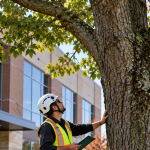
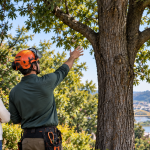
Climbing uses a trained arborist ascending the tree itself, using rope and saddle systems, to reach the canopy from inside the tree’s own structure rather than from an external lift. The climber moves through the canopy making cuts, often rigging sections with ropes and lowering them to the ground in a controlled sequence rather than letting them free-fall.
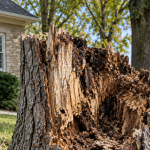
This method requires more time and more coordination on the ground, since a rigging crew is managing ropes and controlling the descent of each cut piece, but it works in places a truck simply can’t go. A climber can access a tree wedged between two houses, growing on a hillside with no truck access, or standing in a backyard behind a gate too narrow for equipment. Climbing is also often the better choice, or the only choice, when a tree has significant decay or structural damage that makes it unsafe to rely on the trunk supporting an external load like a boom resting against it, since the climber can assess the tree’s condition section by section as they ascend.
Comparing the Two Methods
| Factor | Bucket Truck | Climbing |
| Site access needed | Level, clear path, 8-10+ ft wide | Works on tight, gated, or sloped lots |
| Speed on suitable sites | Generally faster | Generally slower, more rigging steps |
| Best for | Open yards, street-side trees, roadside work | Backyards, narrow lots, hillsides, damaged trees |
| Tree condition considerations | Fine for structurally sound trees | Often necessary for trees with hidden decay, since the climber checks each section |
| Typical crew size | Often 2-3 | Often 3-4, including ground rigging crew |
| Cost tendency | Can be lower on straightforward, accessible jobs | Often higher due to time and crew size, though not always |
Why Pittsburgh Properties Often Require Climbing
A meaningful share of Pittsburgh tree removals end up being climbing jobs, not because climbing is preferred in general, but because the city’s housing stock and terrain frequently rule out a truck. Neighborhoods like Polish Hill and the South Side Slopes have narrow streets and steep grades that limit where any vehicle can park, let alone position a boom. Older neighborhoods across the city, including Shadyside and parts of Squirrel Hill, were built with side yards and gated access well under the clearance most aerial trucks need.
Grade adds another layer specific to this region. A tree standing on a hillside lot may have a truck-accessible street in front but a 15-foot drop in elevation to where the tree actually sits, which puts the tree effectively out of boom reach even though the truck itself could physically get close. In these cases, climbing isn’t a fallback option. It’s the only method that actually reaches the tree.
Overhead utility lines complicate things further. Many Pittsburgh properties have service drops running close to the house and through the canopy of a mature tree, which limits where a boom can safely maneuver without approaching the lines. A climber can often navigate around wires more precisely than a truck-mounted boom can, working section by section rather than swinging a large arm through a tight space.
When a Bucket Truck Is the Better Choice
None of this means climbing is always the better or safer option. On the right site, a bucket truck is often faster, requires fewer total labor hours, and reduces the physical demands on the crew, which matters on large or lengthy removals. Trees along a street with clear curb access, trees in open backyards with a driveway wide enough for the truck, and commercial properties with paved lot access are typically well suited to aerial equipment.
Tree condition matters here too. A structurally sound tree in an accessible location is often removed more efficiently with a truck, since the operator can reposition quickly and doesn’t need to rely on the tree itself for support the way a climber does. Our commercial tree services work, which often involves larger properties with better equipment access, frequently uses aerial trucks for exactly this reason.
Safety Standards Behind Both Methods
Professional arboricultural operations are defined by specific standards that prioritize safety and industry expertise, as seen in the study of arboriculture. Both methods operate under specific safety frameworks, not informal judgment calls. Aerial lifts used for tree work fall under OSHA tree care standards, which requires trained and certified operators and specific equipment inspections before use. Federal guidance issued specifically for tree care and tree removal operations also addresses hazard recognition across both aerial lift work and climbing operations, covering everything from electrical line clearance to struck-by hazards from falling limbs.
Climbing work follows its own set of International Society of Arboriculture (ISA) best practices around rope systems, tie-in points, and chainsaw use while aloft, developed by the tree care industry specifically because climbing introduces different risks than ground-based or lift-based work. Neither method is inherently more dangerous when performed by trained crews following these standards. The risk comes from mismatching the method to the site, not from one method being categorically riskier than the other.
What We Commonly See in the Field
The most common misjudgment we see from homeowners, understandably, is assuming a bucket truck is always the faster and cheaper option, and getting a lower quote from a company planning to use one on a site where it genuinely doesn’t fit. What sometimes happens next is a truck getting partway into position, realizing the yard can’t support it, and either damaging the lawn and hardscaping trying to force access, or switching to climbing mid-job with an added cost that wasn’t in the original quote.
We also see the reverse: homeowners assume properties need a climbing crew because the tree looks tucked into a corner of the yard, when a closer look shows a driveway or side alley that actually gives a truck clean access. This is really the whole reason a site visit before quoting matters more than a phone estimate. Our tree removal team walks the actual access route, not just the tree, before recommending a method.
Cost Differences and Why They Exist
Climbing removals are often, though not always, more expensive than comparable bucket truck jobs, and the reason is fairly straightforward: climbing typically requires more time, a larger ground crew to manage rigging, and more careful, incremental cutting to control where each piece lands. A bucket truck operator can reposition in seconds; a climber has to move through the tree physically, re-tying in at new points as the work progresses.
That said, cost isn’t purely a function of method. A large, complicated bucket truck job on a commercial property can cost more than a small climbing removal in a backyard. Tree size, condition, proximity to structures, and disposal or debris removal needs all factor in alongside the removal method itself.
What Homeowners Can Do Now
Before comparing quotes, walk your own property with the same eye a crew would: is there a clear, level path from the street to the tree at least 8 feet wide, and is that path free of gates, steps, retaining walls, or soft ground that could get damaged? If the answer is yes, a bucket truck quote makes sense to expect. If the answer is no, and a company still quotes truck-based work without having walked the site, that’s worth a follow-up question.
If your property has overhead lines running near or through the tree’s canopy, mention that upfront. It changes the equipment plan and sometimes requires coordination with the utility company before work can start.
If a storm has already brought part of the tree down or left it visibly unstable, this isn’t a planning decision anymore. Our 24/7 emergency tree service and storm damage cleanup crews assess the safest method on-site based on the immediate hazard, not a scheduled site visit.
Frequently Asked Questions
Is climbing more dangerous than using a bucket truck?
Not inherently. Both methods carry specific risks that trained, certified crews manage through established safety practices. Climbing involves rope and positioning risk; bucket truck work involves equipment and electrical line risks. The bigger safety issue is using the wrong method for a site, not one method being categorically more dangerous than the other.
Why did one company quote a bucket truck and another quote climbing for the same tree?
This usually comes down to how closely each company assessed site access before quoting. If your property genuinely allows truck access, a company recommending climbing may be quoting conservatively or without a full site visit. If access is actually limited, a truck-based quote may not account for obstacles the estimator didn’t notice or measure.
Can a bucket truck reach a tree in my backyard if my driveway is wide enough?
It depends on what’s between the driveway and the tree, not just the driveway itself. Gates, fences, steps, retaining walls, soft or sloped ground, and the truck’s boom reach from any parking position all factor in. A driveway wide enough for the truck doesn’t guarantee the tree itself is within boom range.
Does climbing take longer than using a bucket truck?
Generally yes, for a comparable tree, since climbing involves ascending the tree, tying in at multiple points, and coordinating rigging with a ground crew for each major cut. A bucket truck operator can reposition faster between cuts. The time difference is one reason climbing jobs are often quoted at a higher cost.
Is a crane ever used instead of a bucket truck or climbing?
Yes, though less commonly, and usually for large trees in locations where neither a truck nor climbing safely handles the tree’s size or condition, such as a heavily decayed large tree near a structure where controlled, piece-by-piece lifting reduces risk significantly compared to either standard method.
Do I need to be home during a tree removal, regardless of method?
It’s not strictly required, but it’s helpful, especially for climbing removals where the crew may need to confirm access through a gate or side yard, or for jobs where drop zone placement needs a quick conversation about landscaping or structures nearby.
Will a bucket truck damage my lawn or driveway?
It can, if the ground is soft, wet, or if the truck’s weight isn’t distributed properly, which is part of why a legitimate site assessment matters before committing to that method. Plywood or mats are sometimes used to protect lawns and driveways during aerial truck work.
Key Takeaways
Bucket trucks and climbing aren’t competing philosophies; they’re two tools suited to different sites and different tree conditions. Bucket trucks work best where a clear, level path gives the truck real access to the tree, which is common on open lots, street-side trees, and commercial properties. Climbing handles everything a truck can’t reach: tight side yards, steep hillside lots, gated backyards, and trees with structural concerns that benefit from a climber assessing condition section by section. Pittsburgh’s terrain and older housing stock mean climbing comes up more often here than in newer, flatter cities, but that doesn’t make it the default or the better option in every case. The right call comes from an actual look at your property, not a generic assumption about which method a company prefers to use.
Not Sure Whether Your Tree Needs a Bucket Truck or a Climbing Crew?
Every property is different. Narrow side yards, steep hillsides, overhead utility lines, and limited access all affect the safest and most efficient way to remove a tree. A professional on-site assessment ensures the right equipment and removal method are chosen before work begins, helping avoid unnecessary costs, delays, or property damage.
Tripoli Tree Care’s ISA Certified Arborists evaluate your tree, surrounding structures, site access, and safety risks to recommend the best approach for your property. Whether your project calls for a bucket truck, a climbing crew, or specialized rigging, you’ll receive an honest recommendation based on your site’s unique conditions.
Schedule your free on-site estimate today.
Call Tripoli Tree Care at (412) 659-8267 or contact us online to speak with an ISA Certified Arborist and book your appointment.