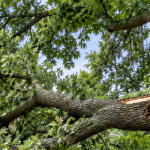
A tree may recover after losing a large branch, but its outlook depends on the extent and location of the damage. Its overall health, remaining canopy, roots, trunk condition, and exposure to future storms also affect what happens next.
Recovery does not mean the missing branch will grow back. Trees respond to injuries by isolating damaged tissue and producing new wood around the wound. The original branch and its structural connection are not restored.
Some trees continue growing for many years after a major branch failure. Others develop decay, canopy decline, or additional structural problems. An on-site assessment is the most reliable way to determine whether the remaining tree can be retained responsibly.
What Determines Whether a Tree Can Survive?
A tree’s ability to survive depends on how much healthy structure and foliage remain after the branch breaks. A smaller branch failure on a healthy tree may have a different outcome than a major scaffold branch tearing into the trunk.
Our arborists consider factors such as:
- The size of the branch compared with the tree
- The amount of live canopy remaining
- The position and shape of the wound
- Whether bark and trunk wood were torn away
- Decay or cavities near the break
- The tree’s age and overall condition
- Root health and soil stability
- Previous drought, construction, pest, or disease stress
- The structure of the remaining canopy
- Exposure to wind, snow, and ice
- What the tree could strike if another failure occurs
No single canopy-loss percentage can determine whether a tree will recover or need removal. The location of the loss and the condition of the remaining structure are equally important.
A tree can remain alive while becoming structurally unsafe. Survival and safety must be evaluated as separate questions.
What Happens After a Major Branch Breaks?
A tree responds to major branch loss by isolating injured tissue and limiting the movement of decay into healthy wood. This defense process is known as tree compartmentalization and natural defense.
Trees do not repair damaged tissue in the same way human skin heals. Instead, they create internal boundaries that slow the spread of decay and other damage. How trees compartmentalize wounds and limit decay explains this natural defense process in more detail.
New woundwood can gradually develop around the edges of an exposed wound. Smaller wounds may close more effectively, while large wounds can remain exposed for years or may never become completely covered with new wood. How trees form woundwood around damaged areas.
Does the Location of the Break Matter?
The break’s location strongly affects the tree’s structural condition and ability to compartmentalize the wound. Damage limited to a branch may be more manageable than a tear extending into the main trunk.
A Break Near the Branch’s Outer End
A branch that breaks near its outer end may leave most of the branch attachment intact. Corrective pruning may be possible if the remaining branch is healthy and structurally sound.
The remaining branch still needs evaluation for cracks or hidden damage. A clean-looking break does not prove that the rest of the branch is stable.
A Break at the Branch Collar
The branch collar is the area where a branch connects to the trunk. It contains specialized tissue that supports the tree’s natural response to a properly placed pruning wound.
If a branch breaks near this area without tearing into the trunk, an appropriate final pruning cut may improve the wound’s position. If the collar itself has been damaged, the tree may have more difficulty limiting decay around the injury.
Bark Torn Down the Trunk
A falling branch can strip bark and wood from the trunk as it separates. This creates a larger wound and may affect tissues that move water, nutrients, and sugars through the tree.
Do not tear away loose but attached bark. Pulling it can enlarge the wound and damage tissue that might otherwise remain functional.
A Major Scaffold Branch Failure
A scaffold branch is one of the main limbs forming the tree’s canopy. Losing one can create a large wound and significantly change how weight is distributed across the tree.
The remaining canopy may become uneven, but that does not automatically mean healthy branches on the opposite side should be removed.
A Codominant Stem Splitting Away
Codominant stems are two or more main stems growing from the same area. If one separates, the split may extend into the trunk and compromise the remaining stem.
This type of damage often needs prompt professional attention. Our guide to a cracked tree trunk after a storm explains more about damage involving the main trunk.
A Break That Exposes Decay
A branch failure may reveal a cavity, discolored wood, or crumbling material that was previously hidden. The decay may have contributed to the break, but the visible opening does not show its full extent.
A professional assessment can consider the exposed area along with the remaining attachment, canopy, roots, and nearby property.
When Is a Broken Branch an Immediate Safety Concern?
A broken branch requires immediate attention if damaged material remains suspended, another part of the tree is cracking, or the remaining structure threatens an occupied area. Keep people and pets away until the hazard has been assessed.
Warning signs include:
- A partially attached or hanging branch
- Fresh cracks in the trunk
- Splitting at another major branch union
- Movement in the remaining canopy
- Lifting roots or moving soil
- Cracking, popping, or tearing sounds
- Damage above a home, road, driveway, walkway, or play area
- A branch touching or threatening utility lines
- Strong wind, heavy rain, snow, or ice expected soon
Do not stand beneath the damaged canopy to inspect it. A suspended limb can fall without a clear warning.
Treat any tree or branch touching a power line as an electrical hazard. Stay away and contact the appropriate utility provider. Call emergency services if there is an injury, fire, blocked public access, or an immediate threat to life.
Tripoli Tree Care provides 24/7 emergency tree services throughout Pittsburgh and the surrounding metro area.
What Should You Do After a Large Branch Falls?
Move away from the tree, check for immediate hazards from a safe position, and contact a qualified tree professional. Do not begin cutting or moving material before the remaining canopy has been assessed.
Follow this sequence:
- Move people and pets away from the tree and fallen branch.
- Check for utility lines, structural damage, fire, injuries, and blocked access from a safe location.
- Contact emergency services or the utility provider when necessary.
- Avoid walking beneath the damaged canopy.
- Do not pull, cut, climb, or move suspended branches.
- Take photographs only from outside the hazardous area.
- Arrange an on-site tree assessment.
A branch on the ground may still be connected to loaded or damaged material above. Moving one section can cause another part of the canopy to shift.
If the damage followed severe weather, our post-storm tree guide provides additional safety information.
What Should You Never Apply to the Wound?
Do not cover a tree wound with household paint, tar, concrete, foam, or homemade sealants. Wound dressings are not routinely recommended for most tree injuries because they can interfere with natural wound closure and may trap moisture.
Property owners should also avoid:
- Cutting flush against the trunk
- Tearing away attached bark
- Filling cavities with concrete or foam
- Drilling into the damaged area
- Attaching chains or straps
- Cutting suspended material
- Using a ladder beneath the damaged canopy
- Removing healthy branches to make the tree look even
- Applying fertilizer automatically to force new growth
A flush cut removes or damages the branch collar and creates a larger wound. Any corrective cut should preserve healthy collar tissue when that tissue remains intact.
Poorly placed cuts cannot be corrected with paint or sealant. The priority is limiting additional injury and allowing the tree’s natural response to proceed.
Can Corrective Pruning Help?
Corrective pruning may help by removing torn material, creating an appropriate final cut, and addressing damaged branches that could fail later. The work should preserve healthy tissue and avoid unnecessary canopy loss.
A broken branch may leave a jagged stub or partially attached wood. A properly planned cut can reduce additional tearing and place the wound where the tree has a better opportunity to compartmentalize it.
Large, elevated, loaded, or suspended branches should be handled by trained professionals. Their weight and tension can make them move unpredictably once cutting begins.
Corrective pruning should also consider the remaining canopy. Removing too much healthy foliage at the same time can add stress to a tree that has already lost a major source of energy.
Our tree trimming and pruning services provide more information about professional canopy care in Pittsburgh.
Should the Remaining Canopy Be Balanced?
An uneven canopy should not automatically be balanced by removing healthy branches from the opposite side. Pruning should address actual structural needs rather than symmetry alone.
Aggressive pruning after a major branch failure can:
- Remove additional energy-producing leaves
- Create more wounds
- Increase sun and heat exposure on previously shaded bark
- Trigger excessive sprouting
- Add stress during recovery
- Change wind movement through the canopy
- Create new structural weaknesses
Some weight reduction may be appropriate if specific remaining branches are overloaded or damaged. That decision should be based on branch structure, attachment, leverage, and the tree’s overall condition.
A tree may never regain its former shape. Retention decisions should focus on health and an acceptable level of structural safety rather than restoring a perfectly balanced appearance.
How Can You Support the Tree’s Recovery?
Support recovery by protecting the roots, avoiding unnecessary treatments, and monitoring the tree over several growing seasons. Conservative care usually helps more than attempts to force rapid growth.
Protect the Root Zone
Keep vehicles, construction materials, and repeated foot traffic away from the root area. Soil compaction can reduce the movement of air and water through the soil.
Avoid trenching, grading, or adding large amounts of soil over the roots. A tree that has lost substantial foliage needs its remaining root system protected from additional stress.
Water According to Actual Conditions
Supplemental water may help during dry periods, but the need depends on recent rainfall, soil drainage, season, species, and site conditions. A fixed schedule is not appropriate for every tree.
Check soil conditions before adding water. Constantly saturated soil can create a different set of problems, particularly where drainage is poor.
Use Mulch Correctly
A moderate layer of mulch can help conserve soil moisture and protect roots from mower damage. Keep mulch away from direct contact with the trunk.
Do not pile mulch against the bark. Deep mulch around the trunk can trap moisture and hide problems at the base.
Avoid Automatic Fertilization
Fertilizer should not be applied simply because a branch broke. It cannot restore missing wood, and stimulating rapid growth may not address the tree’s actual needs.
Soil conditions and the tree’s health should guide any treatment. Unnecessary fertilization can create growth that the damaged structure is not prepared to support.
Prevent Additional Trunk and Root Damage
Keep mowers and string trimmers away from the trunk. Protect exposed roots from cutting, vehicle traffic, and construction work.
Small repeated injuries can create additional stress while the tree is responding to the major wound.
What Warning Signs Suggest the Tree Is Declining?
New structural changes, canopy dieback, and deterioration around the wound may indicate that the tree is not responding well. One symptom alone may not determine the outcome, but changes should be documented and evaluated.
Watch for:
- Cracks that continue expanding
- Additional branch failures
- A developing or increasing lean
- Fungal growth around the wound or tree base
- Soft, crumbling, or discolored wood
- Bark separating near the injury
- Dieback in the remaining canopy
- Sparse or unusually small leaves
- Premature leaf drop
- Heavy sprouting near the wound
- Insect activity around damaged wood
- Root movement or lifting soil
- A cavity expanding around the injury
Photographs taken from the same safe location can help track visible changes over time. Note when symptoms appeared and whether they followed severe weather.
A follow-up inspection may be recommended even if the tree initially appears capable of remaining. Tree condition can change as the wound responds and the remaining canopy adapts.
How Long Does Recovery Take?
Tree recovery is measured over growing seasons rather than days or weeks. The process depends on wound size, species, age, health, site conditions, and whether decay develops.
New tissue may begin forming around the wound’s edges during the growing season. Large wounds take longer to close and may remain visible for many years.
A wound that stays open does not automatically prove that the tree is failing. However, exposed wood can remain vulnerable, so the wound and surrounding structure should be monitored.
Recovery also involves more than wound closure. The tree must maintain enough healthy foliage, roots, and structural support to continue growing without creating an unacceptable hazard.
No professional can promise an exact recovery timeline after seeing only a photograph or general description.
When Might Tree Removal Be the Safer Choice?
Removal may be appropriate when the branch failure causes or reveals structural damage that cannot be managed to an acceptable level. The decision depends on both the tree and what additional failure could affect.
Removal may be considered when there is:
- A split extending into the main trunk
- Significant decay in an important structural area
- More than one recent major branch failure
- Severe damage to a codominant stem
- Root failure or moving soil
- An unstable remaining canopy
- Too little healthy structure to retain the tree responsibly
- A high consequence of failure over an occupied area
Losing one large branch does not automatically mean the tree must be removed. Corrective pruning and monitoring may be reasonable if enough sound structure remains.
Our professional tree removal services explain how we handle trees that cannot be retained safely.
How Does Pittsburgh Weather Affect a Damaged Tree?
Pittsburgh’s wet snow, ice, strong winds, thunderstorms, saturated soil, and freeze-thaw cycles can add stress to a tree after major branch loss. The altered canopy may respond differently to later weather.
Heavy, wet snow and ice add weight to remaining branches. Wind can place new force on parts of the canopy that were previously sheltered by the missing limb.
Saturated soil may affect root support, especially on sloped properties or where drainage is limited. A tree with both canopy damage and root movement needs prompt assessment.
Freeze-thaw conditions can also affect damaged bark and exposed wood. Humid conditions may favor some decay organisms, although the presence and progress of decay vary by tree and site.
Our guide to Pittsburgh weather and tree health explains how seasonal conditions influence local tree care. Our storm damage cleanup service is available when severe weather leaves broken branches or unstable trees.
When Should an Arborist Evaluate the Tree?
An arborist should evaluate a tree after any major branch failure, especially if the tree is large, close to a structure, or showing other signs of damage. An on-site assessment is needed to consider both tree health and structural risk.
Our arborists may evaluate:
- Wound size and position
- Remaining branch attachment
- Trunk condition
- Visible decay or cavities
- Canopy distribution
- Root stability
- Overall tree health
- Nearby homes, roads, and occupied areas
- Access around the property
- Corrective pruning options
- Monitoring needs
- Whether removal should be considered
A basic visual inspection cannot reveal every internal defect. Our ISA Certified Arborists consider the visible evidence, site conditions, failure consequences, and limits of the inspection when recommending the next step.
Frequently Asked Questions
Can a mature tree survive losing a large branch?
Yes, some mature trees survive major branch loss. The outcome depends on the wound, remaining canopy, trunk condition, roots, overall health, and consequences of another failure.
Will the missing branch grow back?
No, the original branch will not grow back. The tree may produce new sprouts and woundwood, but these do not restore the former branch structure.
Should I seal the wound after a branch breaks?
No, wound dressings are not routinely recommended for most tree injuries. Paint, tar, and homemade sealants may interfere with natural wound closure or trap moisture.
Should a damaged branch be cut flush with the trunk?
No, a flush cut can damage the branch collar and enlarge the wound. Corrective pruning should preserve healthy collar tissue when possible.
How long does recovery take after branch loss?
Recovery may continue over several growing seasons, and large wounds can remain visible for many years. There is no universal timeline because tree health, species, wound size, and growing conditions differ.
Does losing one large branch mean the tree must be removed?
No, one branch failure does not automatically require removal. An arborist should evaluate whether enough healthy and stable structure remains.
Can I remove a hanging branch myself?
No, a hanging or partially attached branch can move unpredictably and should be handled by trained professionals. Keep people and pets outside the affected area.
When should an arborist inspect the tree?
Request an inspection after any major branch failure, especially if the tree is near a building, road, driveway, utility line, or occupied space.
Request a Damaged Tree Assessment in Pittsburgh
If your tree has lost a large branch, keep people away from the damaged canopy and avoid cutting suspended material yourself. An on-site assessment can help determine whether corrective pruning, monitoring, or removal is appropriate.
Tripoli Tree Care serves Pittsburgh and surrounding Western Pennsylvania communities with ISA Certified Arborists and 24/7 emergency availability. Call (412) 659-8267 or contact Tripoli Tree Care to schedule an evaluation.