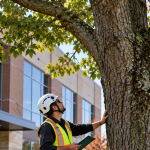
If you own a home in Shadyside, Squirrel Hill, Green Tree, or one of the streets stacked into the South Side Slopes, you already know the problem before you finish reading this sentence. The tree is too close to the house. The yard is too narrow for a truck. The stump sits four feet from your neighbor’s fence. Pittsburgh’s older neighborhoods were platted decades before anyone thought about mature tree canopies growing into 20-foot-wide lots, and now that canopy is exactly the reason so many of these blocks look and feel the way they do.
This guide covers what actually changes about tree care when your lot is small: which species make sense, how access problems affect pruning and removal decisions, what Pittsburgh’s clay soil and steep grades do to root systems, and when a small yard turns a routine trim into a job that needs specialized equipment.
Quick Answer
Small Pittsburgh lots need trees matched to mature canopy width, not just current size, along with more frequent pruning to manage proximity to structures. Narrow side yards and steep grades often rule out bucket trucks, so removals rely on climbing crews and careful rigging. Clay soil common across Allegheny County also means root systems spread wider and shallower than they would in loamier ground, which affects both stability and how close you can safely plant.
Table of Contents
- Why Small Lots Change the Rules for Tree Care
- Pittsburgh’s Soil and Terrain Make This Harder
- Choosing Trees for a Small Pittsburgh Yard
- Pruning on Tight Lots: What’s Different
- When Removal Is the Right Call on a Small Lot
- Access Problems We See Most Often
- What We Commonly See in the Field
- Storms, Power Lines, and Small Yards
- What Homeowners Can Do Now
- Frequently Asked Questions
- Key Takeaways
Why Small Lots Change the Rules for Tree Care
A tree growing in an open half-acre lot and the same species growing eight feet from a foundation wall are not the same maintenance project, even though they’re the same tree. On a small lot, roots compete with sidewalks, gas lines, and sewer laterals. Canopies grow into siding, gutters, and roof valleys instead of open sky. And when something needs to come down, there’s often no clear path to drop it.
Pittsburgh has more of these lots than most cities its size. Neighborhoods like Shadyside were built as a walkable streetcar suburb in the late 1800s, with lots often 20 to 30 feet wide. Squirrel Hill mixes larger lots with tightly packed side streets. Green Tree and the South Side Slopes add grade to the problem, with houses built into hillsides where the “yard” is really a terraced slope. None of this is a flaw in these neighborhoods. It’s part of what makes them dense, walkable, and shaded. But it does mean tree decisions carry more weight than they would in a suburban subdivision.
Pittsburgh’s Soil and Terrain Make This Harder
Much of Allegheny County sits on heavy clay soil, particularly in the western parts of the region. Clay compacts easily, drains slowly, and pushes tree roots to spread wide and shallow rather than deep, which is one reason storm-felled trees here so often come up with a wide, flat root plate instead of snapping at the trunk. For more technical details on regional soil health, consult the Allegheny County Conservation District soil and land management resources. On a small lot, that shallow root spread runs into foundations, patios, and buried utility lines faster than it would on a bigger property.
Grade adds a second layer. On the South Side Slopes or in hillside sections of Green Tree, a tree that looks stable on the uphill side can be significantly undercut on the downhill side, where soil and root support are thinner. Steep lots also limit where a crew can safely stand, rig a line, or stage a chipper, which is the main reason tree work on a hillside lot in Pittsburgh often costs more and takes longer than the same job on flat ground.
Choosing Trees for a Small Pittsburgh Yard
The single biggest mistake we see on small lots is planting for the tree’s size today instead of its size in twenty years. A red maple sapling looks perfectly reasonable six feet from a foundation. The same tree at maturity has a canopy 40 feet wide and roots that will eventually reach the footer.
For narrow Pittsburgh lots, look for species that stay narrower at maturity and tolerate clay soil:
| Tree Type | Mature Width | Clay Tolerance | Good Fit For |
| Serviceberry | 15-25 ft | High | Narrow side yards, near patios |
| American Hornbeam | 20-30 ft | High | Shaded small lots |
| Columnar/upright cultivars (certain maples, oaks) | 10-15 ft | Moderate to high | Tight lots between houses |
| River Birch | 25-40 ft | High | Larger small lots, wetter clay |
| Full-size Red or White Oak | 50-70 ft+ | High | Only where there’s real room to grow |
If you already have a full-size shade tree close to the house, that’s not automatically a problem. It’s a maintenance commitment. A tree that size needs a trained eye checking clearance from the roofline, deadwood over the walkway, and root flare condition every year or two, not a “cut it back when it looks bad” approach. For a broader rundown of species that do well without constant upkeep, our guide on low-maintenance trees for Pittsburgh yards goes deeper into specific varieties.
For more detailed information on regional species suitability, refer to the Penn State Extension tree and shrub selection guide.
If you’re planting new and want it done right the first time, from spacing to soil prep, our tree planting team can walk the lot with you before anything goes in the ground. The same goes for smaller ornamental plantings along a fence line or foundation bed, where our shrub planting crews handle the tighter spacing decisions that come with small yards.
Pruning on Tight Lots: What’s Different
On an open lot, a tree can be pruned from the ground and from a lift with room to maneuver around the full canopy. On a small lot, half the canopy might be pressed against a neighbor’s garage, and the other half might overhang a shared driveway with six feet of clearance on either side.
That changes the approach in three ways:
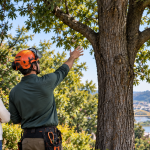
First, access usually means climbing rather than mechanical lifts, since there’s often no path wide enough for a bucket truck, and no legal way to swing a boom over a neighbor’s property without permission.
Second, pruning has to account for what the tree is doing to the structure next to it, not just the tree’s own health. Branches rubbing on siding, roots lifting a walkway, or a canopy shading a roof enough to hold moisture and grow moss are all small-lot-specific problems that don’t show up the same way on a bigger property.
Third, timing matters more. On a tight lot, deferred pruning turns into a bigger job faster, because there’s less room for a branch to grow before it’s touching something. We generally recommend more frequent, lighter pruning on small-lot trees rather than waiting several years and doing one large reduction. Our tree trimming and pruning page covers how we schedule that work by species and site condition.
When Removal Is the Right Call on a Small Lot
Not every small-lot tree needs to come down, but a few situations come up often enough that they’re worth naming directly:
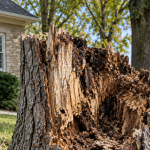
A tree with visible root heave lifting a foundation, patio, or retaining wall is usually past the point where pruning solves the problem. A tree leaning noticeably toward a house, especially after a storm, needs an assessment before the next windstorm decides for you. And a tree that’s outgrown its space to the point where every pruning cycle is a fight to keep it off the roof is often better replaced with something suited to the lot.
Removal on a small lot is its own specialty, which we cover in detail in our companion piece on bucket trucks versus climbing for tree removal in Pittsburgh. The short version: tight lots almost always mean a climbing crew with rigging, not a truck-mounted lift, because there’s no room to position the truck. Our tree removal team plans the drop zone, rigging points, and neighbor notifications before the first cut, which matters more on a small lot than almost anywhere else.
Access Problems We See Most Often
A few access issues come up on nearly every small-lot job in Pittsburgh:
Gates and side yards narrower than standard equipment. Many older Pittsburgh homes have side-yard access under four feet wide, which rules out most wheeled equipment entirely.
Shared driveways and property lines close enough that rigging has to account for a neighbor’s car, fence, or shed, not just your own structure.
Retaining walls and steps on graded lots that limit where a crew can safely stand or stage debris before it goes through a chipper.
Overhead utility lines running close to the house, which is common on lots where the tree and the service drop were never planned around each other. When that’s the case, we coordinate around the lines rather than working blind, and in some cases that means involving the utility company before cutting starts.
What We Commonly See in the Field
On a typical small-lot call in a neighborhood like Squirrel Hill or Green Tree, the tree itself is rarely the surprise. Homeowners usually already know something looks off. What catches people off guard is how much the site itself, not the tree, drives the plan. A silver maple that would be a straightforward bucket-truck removal on an open lot becomes a full-day rigging job on a 25-foot-wide property with a shed on one side and a neighbor’s car parked eight feet from the trunk on the other.
We also see a lot of “it’s been fine for years” trees that have quietly outgrown their space. Nothing changed about the tree’s health. The house is just closer to the canopy than it was ten years ago, because the tree kept growing and the house didn’t move. That’s not a crisis, but it is worth a look before it becomes one, particularly ahead of storm season.
Storms, Power Lines, and Small Yards
Western Pennsylvania has seen its share of serious wind events in recent years, including the widespread straight-line wind damage that hit the Pittsburgh region in spring 2025, which snapped trees and knocked out power to hundreds of thousands of homes across the area. Small lots don’t cause storm damage, but they concentrate its consequences. A large limb failure on an open property might land in the grass. The same failure on a small lot often lands on a roof, a fence, or a car parked in a tight driveway, because there’s nowhere else for it to go.
If a storm has already brought a limb down or left a tree leaning on your property, our storm damage cleanup and debris removal crews handle both the immediate hazard and the cleanup, and our 24/7 emergency tree service line is there for anything that can’t wait for a scheduled visit.
What Homeowners Can Do Now
Walk your property line and note anything touching or nearly touching your house, garage, or fence. That’s the first thing worth mentioning to an arborist, whether or not you think it’s urgent.
Avoid planting large-maturing shade trees within 15 to 20 feet of a foundation, even if the space looks generous today. Check the tree’s expected mature spread, not its size at the nursery.
Don’t wait for a lean or root heave to get worse before having it looked at. On a small lot, the margin between “keep an eye on it” and “this needs to come down now” is often just one storm.
Don’t attempt DIY pruning or removal on a tree close to a structure or power line. The math on tight lots leaves very little room for error, and a miscalculated drop zone on a 25-foot lot has almost no safe direction to fall.
Frequently Asked Questions
What’s the best tree for a small yard in Pittsburgh?
Serviceberry and American hornbeam are two of the most reliable choices for narrow Pittsburgh lots because they stay under 30 feet wide at maturity and handle the region’s clay soil well. Columnar cultivars of maple or oak also work where you want more height without canopy spread. Avoid full-size red maples, silver maples, or oaks unless the lot genuinely has 40 or more feet of clearance in every direction.
How close can a tree be planted to my house?
As a general rule, a large shade tree needs at least 15 to 20 feet from the foundation, and often more depending on the species and soil. Smaller ornamental trees can go closer, sometimes within 6 to 10 feet, but it depends on expected root spread and canopy width at maturity, not the tree’s current size.
Can a bucket truck get into a narrow Pittsburgh side yard?
Usually not. Most bucket trucks need at least 8 to 10 feet of clear, level access, and many Pittsburgh side yards are narrower than that, especially on older lots. In those cases, removal or high pruning is done by a climbing crew using ropes and rigging instead of a truck-mounted lift.
Do I need a permit to remove a tree on my own property in Pittsburgh?
Generally no. The City of Pittsburgh requires a permit for tree work on public property, including street trees and trees in the public right-of-way, but trees entirely on private property typically don’t need one. It’s worth confirming your property line first, since right-of-way boundaries aren’t always where they appear to be.
Why does my small-lot tree need more frequent pruning than a tree in an open yard?
Because there’s less distance between the canopy and the house, garage, or fence, growth that would take years to become a problem in an open yard can become an issue in a single growing season on a tight lot. Lighter, more frequent pruning keeps the tree off the structure without requiring a large, stressful reduction all at once.
What’s the biggest risk with trees on steep Pittsburgh lots?
Uneven root support. On a slope, the downhill side of a tree often has less soil depth and root anchorage than the uphill side, which can make the tree more prone to leaning or failing toward the downhill direction, especially after heavy rain saturates the clay soil common in the region.
How do I know if a tree close to my house needs to come down or can just be pruned?
Look for root heave near the foundation, a visible lean that’s new or worsening, large dead limbs over the roof or walkway, and fungal growth at the base of the trunk. Any one of these is worth a professional look. A tree with none of these signs but simply growing close to the house can usually be managed with regular pruning instead of removal.
Are there trees I should avoid entirely on a small Pittsburgh lot?
Silver maple and Bradford pear are two common problem choices. Silver maple grows fast, gets large, and has weak wood prone to storm breakage. Bradford pear has a narrow branch structure that splits apart as the tree matures, often within 20 years, regardless of lot size.
Key Takeaways
Small Pittsburgh lots change the math on tree care because access, soil, and grade all work against the margin for error that bigger properties have. Choosing species with a mature width that actually fits the lot prevents most future problems. Clay soil and steep grades common across Allegheny County mean root systems spread wide and shallow, which affects both stability and safe planting distance. Removal and high pruning on tight lots usually require a climbing crew rather than a bucket truck, since narrow side yards rarely leave room for equipment access. And on a small lot, keeping up with lighter, more frequent pruning is almost always less disruptive than waiting for a problem to force a bigger decision.
If you’re not sure whether your yard’s tree situation needs a trim, a removal, or just a second opinion, that’s exactly what a site visit is for.
Need Professional Tree Care for a Small Pittsburgh Lot?
Tree care on a small lot requires more than standard equipment and guesswork. Narrow side yards, steep slopes, nearby homes, fences, and overhead utility lines all require careful planning to keep your property safe and avoid unnecessary damage.
Tripoli Tree Care’s ISA Certified Arborists provide expert inspections, precision pruning, hazardous tree removal, and safe rigging solutions for tight residential properties throughout Pittsburgh and Allegheny County. We’ll assess your tree, explain your options, and recommend the safest, most practical solution for your property.
Our arborists adhere to industry-best practices, such as those established by the International Society of Arboriculture (ISA).
Schedule your free on-site estimate today.
Call Tripoli Tree Care at (412) 659-8267 or contact us online to speak with an ISA Certified Arborist and book your appointment.