A tree stump usually takes several years to decay naturally, and a large or decay-resistant stump may remain for a decade or longer. There is no universal timeline because species, size, moisture, drainage, temperature, and biological activity all affect the process.
The visible part of a stump may become soft or hollow before the underground roots fully break down. Even when you can pull pieces from the surface, substantial roots may remain beneath the soil.
Waiting can be reasonable when an old stump sits in an unused area and creates no safety or maintenance problem. Grinding may be more practical when the stump blocks a walkway, interferes with mowing, limits landscaping, produces sprouts, or occupies space you want to reuse.
What Happens as a Tree Stump Naturally Decays?
Natural stump decay occurs as fungi, bacteria, insects, and other organisms gradually break down the wood. Moisture and contact with the surrounding soil help these decomposers reach the stump.
The process usually begins at exposed cuts, damaged bark, cracks, and areas where the stump meets the soil. Fungi can spread through the wood and break down its structural components. Bacteria and insects may contribute as the wood softens and moisture enters.
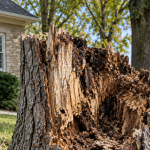
Decay does not usually happen at an even rate. The outside may crumble while the center remains firm, or the interior may become hollow while the outer wood still feels solid. Different parts of the root system can also decay at different speeds.
Seasonal conditions affect biological activity. Decomposition generally slows during cold periods and becomes more active when temperatures and moisture conditions support decomposer organisms.
Which Factors Affect How Quickly a Stump Rots?
The decay rate depends on the stump’s physical characteristics and the conditions around it. Two stumps removed at the same time can follow very different timelines.
Major factors include:
- Tree species and natural decay resistance
- Wood density
- Stump diameter
- Stump height
- Whether the tree was alive or dead when cut
- Soil contact around the stump
- Soil moisture and drainage
- Sunlight and shade
- Temperature changes
- Fungal and microbial activity
- Insect activity
- Existing wounds or decay
- Whether the stump continues producing sprouts
- The size and condition of the underground roots
A single factor rarely determines the full timeline. A large stump made of decay-resistant wood may remain for years even in a moist location. A smaller stump with existing decay and good soil contact may soften sooner.
Does Tree Species Affect the Decay Rate?
Yes, tree species can significantly affect natural stump decay because wood density and decay resistance vary. Dense or naturally durable wood generally breaks down more slowly than less resistant wood. The USDA Forest Service Wood Handbook documents differences in wood properties and decay resistance among species.
The broad labels “hardwood” and “softwood” do not provide a precise decay timeline. Some hardwood species decay faster than others, and certain species have naturally decay-resistant heartwood. Research from the USDA Forest Service on wood decay and species differences shows that decay rates can vary between tree species.
Species identification can help us estimate how a stump may behave, but it cannot produce an exact date when the stump will disappear. The tree’s age, previous condition, growing site, and moisture exposure also remain important factors.
Mature hardwoods are common throughout Western Pennsylvania, so Pittsburgh-area property owners may be left with substantial stumps after planned or storm-related tree removal. These larger stumps can remain noticeable long after the trunk and branches are gone.
Does Stump Size Affect Decomposition?
Yes, wider and taller stumps generally take longer to decompose because they contain more wood. A thick stump also has less exposed surface area relative to its total volume.
A small stump may soften and crumble while a wide stump from a mature tree remains firm at its center. Large roots extending from the stump add more woody material below ground.
Stump height matters as well. A low stump has more contact with soil and retains less aboveground wood than a tall stump. However, size alone does not determine the rate. Species, moisture, and existing decay can make a smaller stump persist longer than expected. Research on woody debris decay rates from the USDA Forest Service also identifies species, size, decay stage, and site conditions as factors that influence decomposition.
How Do Moisture and Drainage Affect Stump Decay?
Moderate moisture supports the fungi and microorganisms involved in wood decomposition. A very dry stump may decay slowly because biological activity is limited. Penn State Extension explains how wood-decaying fungi depend on moisture, oxygen, food, and favorable temperatures.
More water does not always mean faster or better decomposition. Waterlogged ground may create drainage problems, unstable soil, or unsuitable conditions for future planting and landscaping. Continually soaking a stump is not a reliable solution.
The location of the stump also matters. One stump may sit in a shaded area that retains moisture, while another receives direct sun and dries quickly. A stump near a retaining wall, driveway, or slope may experience different drainage conditions across its root area.
Does Pittsburgh’s Climate Affect the Timeline?
Yes, Pittsburgh’s seasonal temperature and moisture changes can influence stump decomposition. Warm, humid periods may support biological activity, while colder winter conditions generally slow the process.
Rainfall does not affect every site in the same way. Some yards drain quickly, while others retain water because of grading, compaction, or surrounding hard surfaces. Stumps on sloped properties may also receive uneven moisture.
Freeze-thaw cycles can contribute to cracking and physical weathering, but they do not make a large stump disappear in one season. Natural decomposition remains a gradual biological process.
Our tree-care blog provides additional information about local tree health, seasonal stress, and property maintenance in the Pittsburgh area.
How Can You Tell That a Stump Is Decaying?
A decaying stump usually becomes softer, looser, and easier to break apart over time. The change may begin in isolated areas rather than across the entire stump.
Visible signs may include:
- Softening wood
- Bark separating from the stump
- Crumbling edges
- Deep cracks
- Hollow sections
- Fungal growth
- Increased insect activity
- Darkened or water-soaked wood
- Reduced or stopped sprouting
- Small sections breaking away easily
Mushrooms growing from a stump indicate fungal activity, but they do not prove that the entire stump has decomposed. Firm wood may remain below the surface or deep inside the stump.
Insects also use dead and decaying wood. Their presence does not automatically mean the yard has an infestation or that the stump is about to collapse. Look at the location, condition, and surrounding property before deciding what action is needed.
Can a Stump Grow Back Instead of Decaying?
Yes, some tree species can produce new sprouts from the stump or remaining roots. Active regrowth may keep portions of the root system alive and delay the practical end of the stump.
Sprouts often emerge around the cut surface, trunk base, or nearby roots. Cutting them back repeatedly may remove visible growth without addressing the surviving root system.
Not every stump will regrow. The likelihood depends on the species, tree condition, time of removal, stored energy in the roots, and whether the stump remains biologically active.
Professional evaluation can help determine whether you are seeing temporary sprouting or continued regrowth that may interfere with plans for the area. Avoid applying an unidentified chemical solely because new shoots appear.
What Problems Can Develop While You Wait?
Waiting for natural decay may leave the stump in place for years. During that time, it can interfere with the way you use or maintain the property.
Possible concerns include:
- A tripping hazard in an active part of the yard
- Interference with mowing and lawn maintenance
- Reduced space for landscaping
- Recurring sprouts
- Fungal growth
- Insect activity within decaying wood
- An obstacle near a walkway or driveway
- Conflicts with a fence, patio, or construction plan
- Difficulty reseeding or grading the area
- Limited usable space on a small property
A stump does not automatically create every problem on this list. Location is often the deciding factor.
A low stump in a wooded corner may cause little concern. The same stump beside a walkway, play area, rental-property entrance, or maintained lawn may require attention much sooner.
Branches, logs, and other material left from tree work can create separate maintenance needs. Our tree debris removal service addresses woody material that needs to be cleared from the property.
Is It Safe to Leave a Stump in the Yard?
Leaving a stump may be reasonable if it is stable, visible, out of the way, and not interfering with property use. A stump in an active area may create a preventable trip or maintenance hazard.
Consider who uses the space and how often. Children, visitors, tenants, customers, lawn crews, and delivery workers may not notice a low stump. Tall grass, leaves, or snow can make it harder to see.
The stump’s condition also matters. Loose wood may break under pressure, while hollow sections can make the surface less predictable. Stumps near a slope, retaining wall, driveway, or structure deserve additional attention because the surrounding area may have other access or stability concerns.
If you decide to leave the stump, continue monitoring it as conditions change. A stump that caused no problem last year may become a concern after it softens, sprouts, or becomes hidden by new landscaping.
Should You Wait for Natural Decay or Grind the Stump?
Waiting costs less upfront and allows decomposition to proceed naturally, but it can require years of patience. Stump grinding provides a faster way to reclaim the surface area without excavating every underground root.
The right choice depends on the stump’s location, your plans, and how much inconvenience it creates.
Waiting for Natural Decay May Make Sense When:
Waiting may be suitable when the stump is outside active areas and does not interfere with property maintenance.
It may be reasonable if:
- The stump is in an unused or wooded part of the property
- It does not create a tripping concern
- You do not need the space for landscaping
- The stump does not interfere with mowing
- No construction or grading is planned nearby
- Recurring sprouts are not creating a problem
- You are comfortable monitoring the stump over time
- An uncertain decay timeline does not affect your plans
Natural decay requires patience. The stump may remain visible long after its outer surface begins softening.
Stump Grinding May Make More Sense When:
Grinding may be more practical when you want to use the area without waiting several years for decomposition. It is also worth considering when the stump creates a hazard or recurring maintenance problem.
Grinding may be appropriate when:
- The stump is near a walkway, driveway, or play area
- You want to reclaim usable lawn space
- Mowing around the stump is difficult
- The stump continues producing sprouts
- Landscaping or construction is planned
- The stump occupies a small or closely spaced yard
- Its appearance conflicts with your property goals
- You need to prepare the surface for reseeding
- You want the stump addressed as part of a larger cleanup
Our stump grinding service in Pittsburgh provides more information about professional removal options. An assessment helps us account for stump size, access, nearby utilities, hardscaping, and your plans for the space.
Can You Speed Up Natural Stump Decay?
You may be able to support natural decomposition by maintaining ordinary soil contact and avoiding conditions that keep the stump extremely dry. Results will still be slow and unpredictable.
Do not pour gasoline, diesel, bleach, excessive salt, or unverified chemical mixtures onto the stump. These substances can create safety concerns and affect surrounding soil or vegetation.
Burning is also inappropriate without confirming local rules, fire conditions, underground hazards, and property risks. Fire can spread through dry material or persist within roots and cavities.
Do not deliberately introduce termites or other pests. They will not remain limited to the stump simply because that was the intended target.
Using a chainsaw below ground level can expose the operator to soil, stones, hidden metal, and severe equipment hazards. Rented stump grinders also require knowledge of machine operation, underground utilities, protective equipment, and site control.
Commercial stump-removal products vary. If you choose to use one, follow the label exactly and confirm that its use is allowed for your location. Do not assume a product will produce a specific result or make the stump immediately safe to remove.
What Happens to the Roots After Stump Grinding?
Stump grinding usually addresses the visible stump and accessible portions of the root flare rather than removing every underground root. The remaining roots generally break down gradually in the soil.
Root decomposition has its own timeline. Large structural roots may remain underground after the surface stump is gone, while smaller roots may deteriorate sooner.
As buried roots decay, the soil may settle in some areas. The amount of settlement depends on root size, soil conditions, fill material, and how the space is used.
Grinding and full root excavation are different scopes of work. Excavating an entire root system can disturb a much larger area and may affect nearby utilities, hardscaping, retaining walls, or landscaping.
Tell our team how you plan to use the site. Preparing the surface for lawn restoration may require a different approach from preparing for construction or a new tree.
Can You Plant a New Tree Where the Old Stump Was?
Planting directly in the former stump location may be difficult because remaining roots, wood chips, settling soil, and limited growing space can affect the new tree. A nearby planting location may provide better conditions.
The reason the previous tree was removed also matters. Disease, poor drainage, restricted root space, utility conflicts, or unsuitable placement may still affect the site.
Fresh wood chips mixed heavily into the planting soil can influence moisture and nutrient conditions as they decompose. The area may also settle as old roots break down.
Before planting, evaluate:
- The remaining root system
- Soil condition and drainage
- Available space for mature growth
- Sunlight exposure
- Nearby buildings and utilities
- The previous tree’s condition
- Future maintenance needs
Our tree planting service can help determine whether the original location or another part of the property is more suitable.
How Does Our Team Assess an Old Stump?
Our team evaluates the stump, surrounding property, and your plans for the area before recommending a service. The same approach will not work for every stump.
During an on-site visit, we may look at:
- Stump diameter and height
- Tree species, when identifiable
- Remaining sprouts
- Visible decay and hollow areas
- Root flare and surface roots
- Yard slope and ground conditions
- Access for workers and equipment
- Nearby utilities
- Distance from buildings and hardscaping
- Proximity to walkways or driveways
- Cleanup preferences
- Future landscaping or construction plans
- Whether you want to reseed or replant
Limited backyard access can affect the equipment and work plan. Closely spaced homes, fences, retaining walls, landscaping, and sloped yards may also require additional planning.
Tripoli Tree Care provides professional tree care throughout our Greater Pittsburgh service area. Our recommendations are based on the actual stump and property rather than a general timeline.
Frequently Asked Questions About Natural Stump Decay
How many years does it take for a stump to rot completely?
Complete decomposition usually takes several years, and some large or decay-resistant stumps can remain for a decade or longer. Species, diameter, wood density, moisture, temperature, and soil contact affect the timeline. The visible stump may soften before the underground roots fully decay.
Do hardwood stumps take longer to decay?
Some hardwood stumps decay slowly because their wood is dense or naturally resistant, but the hardwood label alone does not determine the timeline. Species, stump size, existing decay, moisture, and biological activity can be just as important.
Will drilling holes make a stump decay faster?
Increasing the exposed surface area may influence decomposition, but it does not create a predictable or immediate result. Drilling can also involve equipment and site hazards. Do not combine holes with fuel, fire, excessive salt, or unverified chemicals.
Can a decaying stump attract insects?
Yes, some insects use dead or decaying wood for food or shelter. Their presence does not automatically indicate a broader infestation. If you notice substantial insect activity, identify the insect and assess the surrounding property before choosing a response.
Will the roots die after the tree is removed?
Roots usually die and decay after removal, but some species may produce sprouts from the stump or remaining roots. Large underground roots can remain long after visible growth stops. The decay rate varies with species, size, soil conditions, moisture, and biological activity.
Is stump grinding better than waiting for natural decay?
Grinding is often more practical when the stump creates a hazard, interferes with maintenance, or occupies space you want to reuse. Waiting may be reasonable when the stump is out of the way and an uncertain timeline does not affect your plans.
Ask Our Team About an Old Stump
An old stump may take years to decompose, and the underground roots may remain even after the surface begins crumbling. If the stump interferes with mowing, landscaping, access, safety, or future planting, you do not have to wait for natural decay.
Contact Tripoli Tree Care or call (412) 659-8267 to request an assessment or stump-grinding estimate. Our team can evaluate the stump, access, surrounding property, and your plans for the area.