Understanding Pittsburgh’s urban forestry landscape is essential for managing local properties, as the unique Western Pennsylvania climate challenges often put significant stress on even the healthiest mature trees.
The storm passes, the wind dies down, and there’s a tree down in the yard, or worse, leaning into the house. The instinct is to go outside and start assessing the damage up close. That instinct is exactly what gets people hurt.
Key Takeaways
- Treat every downed line and anything touching it as energized, even without visible sparking.
- A fallen tree can still be under structural stress and may continue to shift in the days after a storm.
- Pittsburgh’s hillside lots add risk, since a failed tree on a slope can continue moving downhill.
- Photograph damage immediately, before cleanup begins, to support your insurance claim.
- A hung-up tree or one touching a structure needs emergency response, not a scheduled appointment.
This article covers the specific first steps to take in the minutes and hours after a storm damages your trees, what makes a downed tree more dangerous than it looks, and how to protect your insurance claim before scheduling any tree removal or cleanup.
What Should I Do First After a Storm Damages My Trees?
The first step after storm damage is to stay away from anything the tree is touching, especially power lines, and treat every downed line as live until a utility crew confirms otherwise. Everything else, from documentation to cleanup, comes after that basic safety check, not before it.
Why a Downed Line Is Dangerous Even Without Sparks
A lot of people assume a power line is only dangerous if it’s actively sparking or arcing. That assumption has gotten people seriously hurt.
Duquesne Light advises treating every downed line as energized, including anything touching it, since electricity can travel through wet grass, standing water, or even a puddle the line happens to be resting in without any visible warning sign. A branch resting quietly across a wire can be just as dangerous as one that’s actively sparking. If a tree or limb is touching a line, the entire area around it, not just the wire itself, should be treated as a hazard zone until Duquesne Light or emergency responders confirm it’s safe.
The Tree Isn’t Done Moving Just Because It’s Down
Here’s the assumption that catches people off guard: once a tree has fallen, most homeowners figure the danger has passed and the situation is now just a cleanup job.
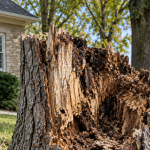
A tree that’s fallen against your house, wedged into a neighboring tree, or resting at an angle on your roof is often still under real structural stress. Branches continue to settle and shift under their own weight, and in Pittsburgh’s winter storms, any additional snow or ice accumulating on an already-compromised tree adds weight to a structure that’s no longer stable. A tree that looks like it’s finished moving on the day of the storm can shift further, sometimes significantly, in the days that follow, particularly if more precipitation is on the way.
Why Pittsburgh’s Hillside Lots Add a Layer of Complexity
Pittsburgh’s terrain creates a wrinkle that flatter cities don’t deal with as often: a tree that fails on a slope doesn’t necessarily stay where it lands.
On steep lots common in neighborhoods like Mt. Washington or the South Side Slopes, a tree that comes down partway can continue sliding or shifting further downhill as the saturated, clay-heavy soil underneath loses its grip, sometimes affecting a property or structure below the original tree that wasn’t part of the initial damage. This is one of the reasons a hillside storm call gets assessed differently than the same tree failure on flat ground.
What to Do in the First Hour
- Keep everyone, including pets, away from the tree and anything it’s touching
- Treat any contact with a power line as an active emergency; call 911 and report downed or low wires to Duquesne Light at 888-393-7000
- Photograph the damage from multiple angles before anything is moved or cleaned up
- Avoid walking under or around a tree that’s leaning, hung up in another tree, or resting on a structure
- Do not attempt to cut large limbs or sections yourself, especially anything under tension or resting on your roof
Documenting Damage for Your Insurance Claim
What you do in the first hour also shapes how smoothly your insurance claim goes later. Photos taken immediately, before any debris is moved, give your insurer a clear record of the damage as it actually happened.
A professional storm damage cleanup crew typically provides written assessments and photographic documentation as part of the job, which gives your insurance provider what it needs to process a claim without extra back-and-forth. Once documentation is complete, debris removal can move quickly, since branches, logs, and loose material are hauled away as part of the same visit. Waiting several days to call, while the damage continues to settle or worsen, tends to complicate that process rather than simplify it.
To ensure the highest standard of safety and professional care during extraction, it is recommended to verify that your tree service team holds valid ISA Certified Arborist credentials.
Scheduled Cleanup vs. Emergency Response
| Situation | Typical Response |
| Tree fully down, clear of structures and power lines | Scheduled cleanup, often within a day or two |
| Tree resting on a roof, garage, or deck | Priority response, same day when possible |
| Tree touching or near a power line | Immediate; call 911 and the utility first |
| Tree hung up in a neighboring tree’s branches | Immediate; treat as high-risk until assessed |
| Large limb blocking a driveway or street | Priority response for access, full cleanup to follow |
Signs the Situation Needs Emergency Response, Not a Scheduled Visit
- Any part of the tree is touching a power line
- A tree is resting on your roof, garage, or another structure
- A large limb is visibly cracked and still hanging in the canopy
- The tree is blocking your only way in or out of the driveway
- The tree has shifted since the storm passed, even slightly
Frequently Asked Questions
How fast can I get emergency tree service after a storm in Pittsburgh?
Response times depend on storm severity and call volume across the region, but situations involving structures, power lines, or blocked access are prioritized first. 24/7 emergency tree service is available for exactly these situations, day or night.
Is it safe to move small branches myself after a storm?
Small, loose debris away from power lines and structures is generally safe to move. Anything resting on a structure, tangled in another tree, or near a power line should be left to a professional, since what looks stable can still be under tension.
Will my homeowners insurance cover storm damage to my trees?
Coverage depends on your specific policy and whether the tree damaged an insured structure. Storm-related failures that hit a roof, fence, or garage are commonly covered; a tree that falls into an open yard without hitting anything often is not. Check with your insurer for your specific coverage.
What if a tree fell on my neighbor’s property from my yard?
This depends on the specific circumstances and your policies, and is worth discussing directly with your insurance provider. In the meantime, safety and documentation steps are the same regardless of whose property the tree ultimately landed on.
Do I need a permit to remove a storm-damaged tree in Pittsburgh?
Trees entirely on private property generally don’t require a permit for emergency removal, but trees in the public right-of-way, between the sidewalk and street, belong to the city and go through Pittsburgh’s forestry division. We check what applies to your specific address before starting work.
How long after a storm can hidden tree damage still show up?
It varies, but internal stress, root plate loosening, and slow-developing cracks can take days or even weeks to fully reveal themselves, especially if more wind, rain, or snow follows the original storm. A professional inspection after major storm activity can catch damage that isn’t obvious yet.
What Pittsburgh Homeowners Should Remember After Storm Damage
The moment a storm passes isn’t the moment the danger ends. What a tree does in the hours and days afterward, especially on Pittsburgh’s hillside lots and clay-heavy soil, often matters more than the initial damage itself.
If a storm has brought a tree down on your property, whether it’s touching a power line, resting on your roof, or just blocking your driveway, Tripoli Tree Care provides 24/7 emergency response across the Pittsburgh metro area. Call (412) 659-8267 any time, day or night, and we’ll get a crew assessing the situation quickly.